The short answer
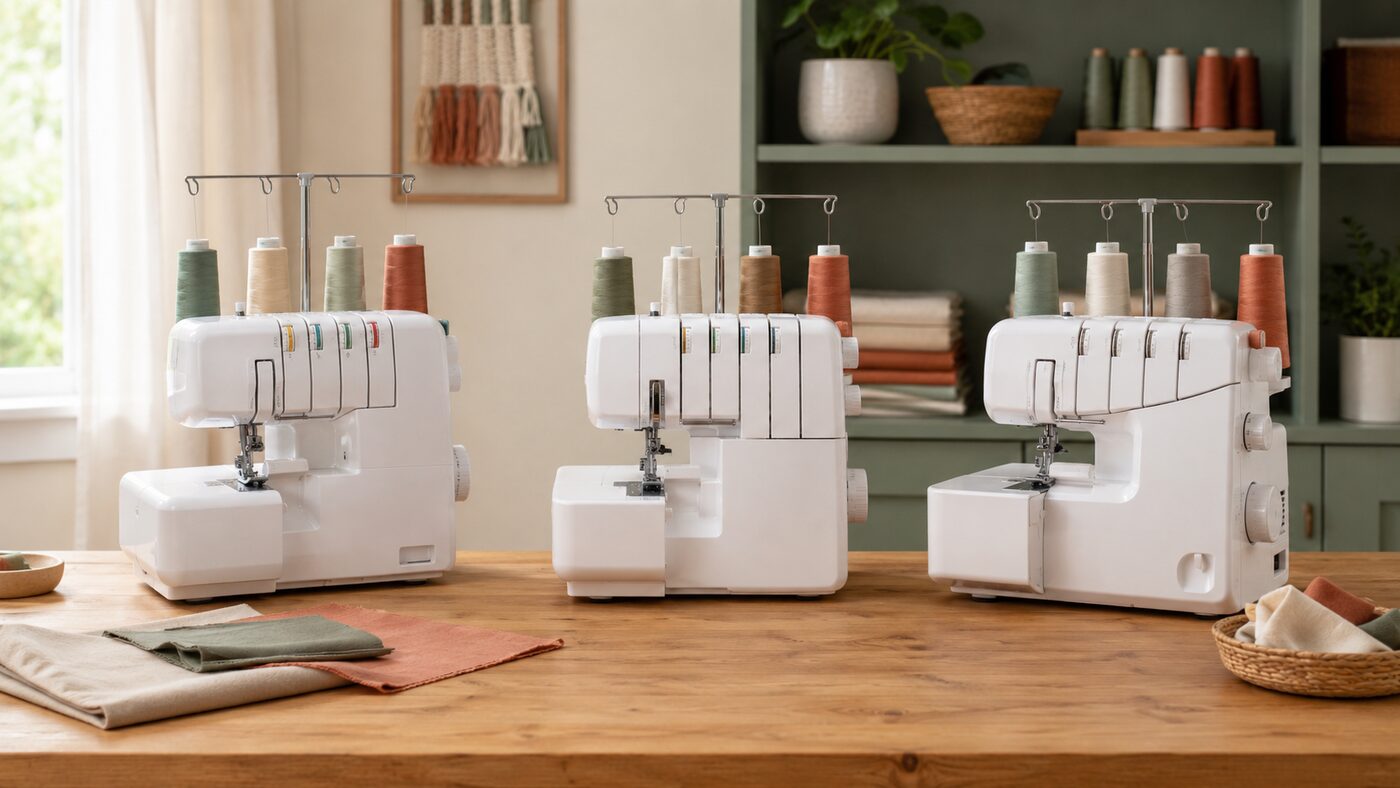
These three machines serve slightly different beginners. On published specifications, the Brother 1034DX makes the strongest case when included feet and a lower direct price matter, but Brother showed it as out of stock. The Janome 8002D offers the clearest published adjustment ranges and dealer-led purchase route. The Singer S0100 provides the widest thread configuration here, a free arm and direct availability.
Those are specification-based fits, not star ratings. We have not sewn the same test fabrics on all three machines, measured noise or timed complete rethreading. A dealer demonstration can reveal more about comfort and visibility than a long feature list.
For a deeper evidence check on one model, read the Janome 8002D review for US beginners, including the official manual, current dealer price and warranty limitations.
Comparison at a glance
| Machine | Threads | Threading | Speed | Price snapshot |
|---|---|---|---|---|
| Brother 1034DX | 3 or 4 | Colour-coded manual | 1,300 spm | $289.99 |
| Janome 8002D | 3 or 4 | Colour-coded lay-in | 1,300 spm | $399 listed |
| Singer S0100 | 2, 3 or 4 | Colour-coded lay-in | 1,300 spm | $299.99 |
How we narrowed the field
We selected current machines from official US ranges that provide colour-coded threading, differential feed and at least four-thread overlocking. Those are practical foundations for garment seams and edge finishing. We then separated the evidence into four questions:
- Can a beginner understand and access the thread path?
- Does the machine provide useful control over stretch, puckering and seam width?
- What equipment is included rather than sold separately?
- Is there a credible US purchase, warranty and support route?
We did not use marketplace star ratings as performance evidence. Reviews can identify recurring questions, but different experience levels, setup errors and seller fulfilment problems make them unsuitable as a substitute for controlled testing.
Brother 1034DX: strongest included-foot package
Brother lists the 1034DX at $289.99, although its direct store showed the machine as out of stock at our check. It handles three or four threads, uses colour-coded guides and reaches 1,300 stitches per minute. Differential feed, rolled-hem conversion, adjustable presser-foot pressure and standard sewing-machine needles cover the main beginner requirements.
The package includes standard, gathering and blind-stitch feet, plus starter thread spools. That reduces the number of immediate extras a new owner may need. Brother publishes a 1/5/25-year limited serger warranty, but buyers should read which components fall into each period.
Consider it if: you want a conventional four-thread beginner machine with more useful feet in the box and can find it through an authorised US seller.
Pause if: two-thread stitches or a free arm are important, or the local seller cannot explain warranty and support arrangements.
Janome 8002D: clearest published adjustment range
Janome lists the 8002D at $399 and directs buyers to authorised dealers for pricing. It is a three or four-thread machine with lay-in tension, colour-coded guides, quick rolled-hem conversion and a retractable upper knife. Its published differential-feed range is 0.5 to 2.25, cutting width is 3.1 to 7.3 mm, and stitch length runs from 1 to 4 mm.
Those stated ranges give a learner useful room to control stretching, gathering and edge coverage. Adjustable foot pressure also matters when moving between light and heavier fabrics. The trade-off is that the official standard-accessory list is less generous than Brother’s included-foot bundle, while the actual selling price depends on the dealer.
Consider it if: you value explicit adjustment ranges, dealer support and a straightforward three or four-thread setup.
Pause if: you want a free arm, two-thread stitches or several specialist feet included at purchase.
Singer S0100: broadest published stitch flexibility
Singer showed the S0100 at $299.99 against a stated $379.99 MSRP. It supports two, three or four-thread stitches, colour-coded lay-in threading and differential feed, with a maximum speed of 1,300 stitches per minute. Singer also lists six built-in stitches, a built-in rolled hem, a movable upper knife and a free arm for cuffs and other small openings.
The two-thread option makes it the most flexible of this shortlist on paper. The free arm may also help with small tubular pieces. Its general-purpose foot is the only presser foot named in the included-accessory list, so specialist techniques may require additional purchases.
Consider it if: two-thread finishes, a free arm and direct US availability matter more than an expanded foot bundle.
Pause if: you prefer dealer-led setup support or want several task-specific feet included.
Which one fits which beginner?
Brother 1034DX
Best specification fit for included feet
Three included feet and standard sewing-machine needles
Availability: Out of stock direct
Janome 8002D
Best specification fit for adjustment range
Published cutting width of 3.1 to 7.3 mm and adjustable foot pressure
Availability: Authorised dealers
Singer S0100
Best specification fit for stitch flexibility
Six built-in stitches, free arm and movable upper knife
Availability: Available direct
What specifications cannot tell you
A specification sheet cannot establish whether one machine produces a better seam, vibrates less, is easier to clean or remains easier to thread after a break. It also cannot tell you which control layout works with your eyesight, hand strength or workspace. That is why these machines are shortlisted rather than scored.
If possible, take two fabrics you actually sew to a dealer: a stable woven and a stretchy knit. Ask to thread from empty, change from four threads to three, create a rolled hem and restore the original stitch. A machine that feels understandable during those tasks is usually a better first purchase than one chosen for an extra stitch you may never use.
Before you buy
- Confirm the exact model and that it is intended for US 120-volt, 60 Hz supply.
- Read the complete warranty rather than relying on the longest number in its headline.
- Check whether the seller is authorised and who handles repairs locally.
- Price the feet, needles, thread, oil and cover that are not included.
- Download the manual and judge whether the threading diagrams are usable for you.