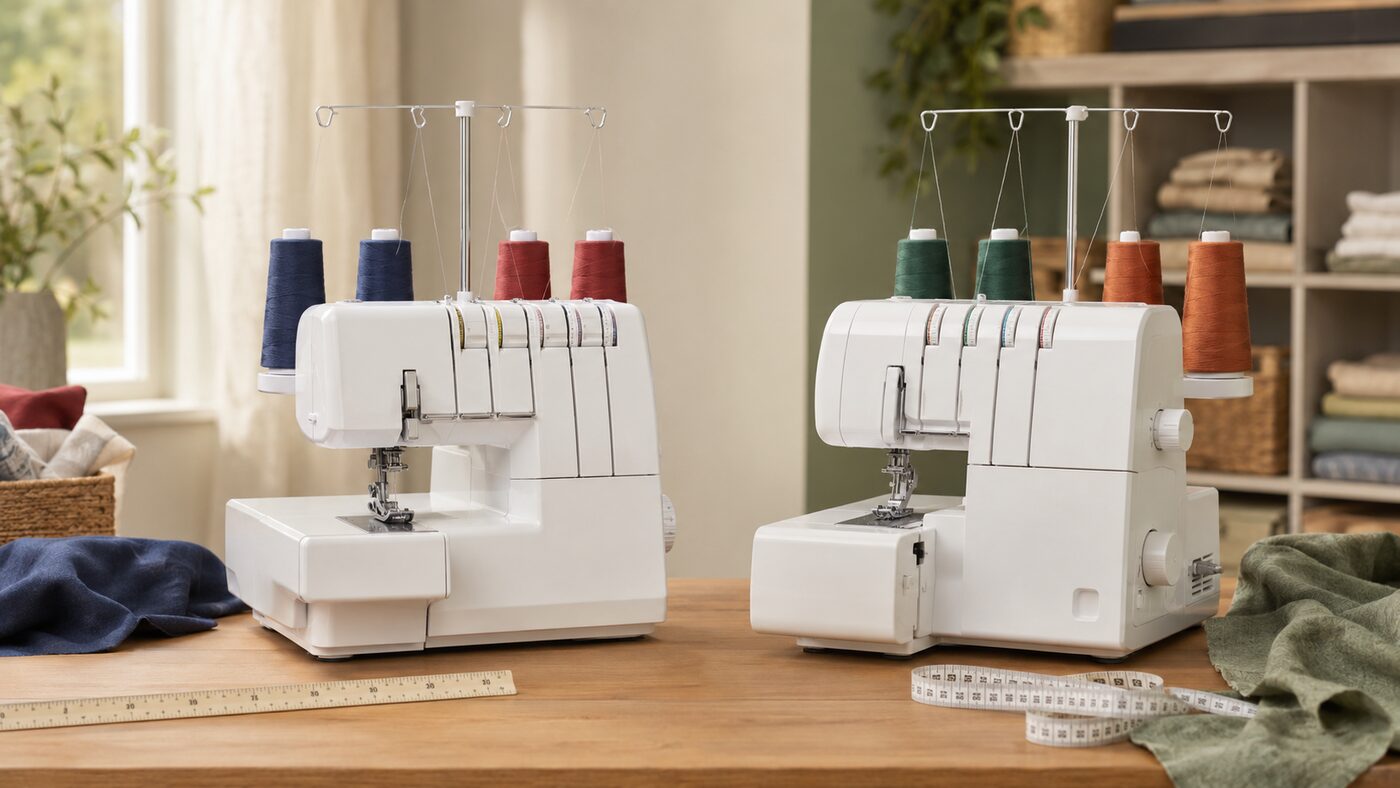
Why one machine can have two buying contexts
Manufacturers organise their ranges around local distribution. A machine sold in the United States may have a different name, electrical specification, accessory bundle, warranty and dealer network from a machine serving a similar buyer in the United Kingdom. Sometimes the mechanics are closely related. Sometimes only the market position is similar.
For that reason, The Serger Edge uses model family to mean machines that belong in the same buying conversation. It does not mean they are interchangeable, and it is not a claim that one is a rebadged version of the other.
Our four comparison groups
Entry-level Brother
US: Brother 1034DX
UK: Brother 2104D
Both are four-thread-capable, colour-coded machines aimed at accessible home overlocking. Their threading aids, supplied accessories, electrical specifications and warranty terms differ by market.
Entry-level Janome
US: Janome 8002D
UK: Janome 9300DX
Both sit in Janome’s straightforward manual-threading range and share features such as differential feed and rolled-hem conversion. The official sources do not establish them as the same machine.
Air-threading Brother
US: Brother AIR1800
UK: Brother Airflow 3000
Both compete for buyers who want air-assisted looper threading. Similar positioning does not prove identical controls, packages or regional support.
Juki cross-market benchmark
US: Juki MO-654DE
UK: Juki MO-654DEN
Official specifications are closely aligned, including 2, 3 or 4-thread operation, differential feed and a 1,500-stitch-per-minute maximum. They still remain region-specific purchases.
Entry-level Brother: comparable purpose, different products
The US Brother 1034DX and UK Brother 2104D both occupy the approachable end of their regional ranges. Each supports three or four-thread overlocking and uses colour-coded guidance. The US specification lists differential feed, a maximum sewing speed of 1,300 stitches per minute and 110-volt certification. The UK 2104D highlights its F.A.S.T. lower-looper threading aid.
Those shared fundamentals make them useful peers for beginners, but not confirmed equivalents. A buyer should compare the actual threading route, supplied feet, local price, warranty and service access rather than import whichever listing appears cheaper.
Entry-level Janome: similar feature language is not proof
Janome’s US 8002D and UK 9300DX are both three or four-thread machines with colour-coded manual threading, differential feed, retractable upper knives and quick rolled-hem conversion. Both official specifications state a maximum speed of 1,300 stitches per minute.
Their published measurements are not identical, and neither regional source declares them to be equivalent. We therefore compare them as machines for a similar type of buyer, while preserving their separate model identities.
Air-threading Brother: compare the assistance itself
The Brother AIR1800 in the US and Airflow 3000 in the UK both target users who want air-assisted looper threading. That places them in the same premium convenience category. It does not mean their needle-threading systems, controls, stitch packages or support terms are the same.
When evaluating an air-threaded machine, ask which loopers use air, whether the needles have separate assistance, whether threading order matters, and what happens if thread becomes lodged in a tube. Those answers are more useful than the feature name alone.
Juki MO-654DE and MO-654DEN: the closest comparison here
The official US MO-654DE and UK MO-654DEN information aligns on several central specifications: two, three or four-thread operation, differential feed from 0.7 to 2.0, stitch length up to 4 mm and a maximum speed of 1,500 stitches per minute. This makes the pair a strong candidate for close cross-market comparison.
Even here, the buying decision remains local. The UK distributor supplies UK warranty and support, while the US product belongs to a different sales and service network. Exact electrical requirements and the contents of the box should be confirmed from the listing and manual for the specific unit being purchased.
Five checks before comparing prices
- Exact SKU: confirm every letter and suffix, not just the family name.
- Electrical supply: match voltage, frequency and plug to the country of use.
- Warranty territory: determine whether local service covers an imported unit.
- Included equipment: compare feet, waste tray, cover, needles and other accessories.
- Local support: check manuals, parts, training and authorised repair access.
Currency conversion comes last. A converted price does not include import tax, delivery, electrical adaptation, lost warranty coverage or the inconvenience of returning a machine abroad.
How this guides our future reviews
Individual reviews will use the specification and support evidence for the country where the model is sold. US and UK prices will be dated local snapshots, not conversions. A rating for one regional model will not automatically transfer to another. Where hands-on testing has not occurred, the page will say so prominently.