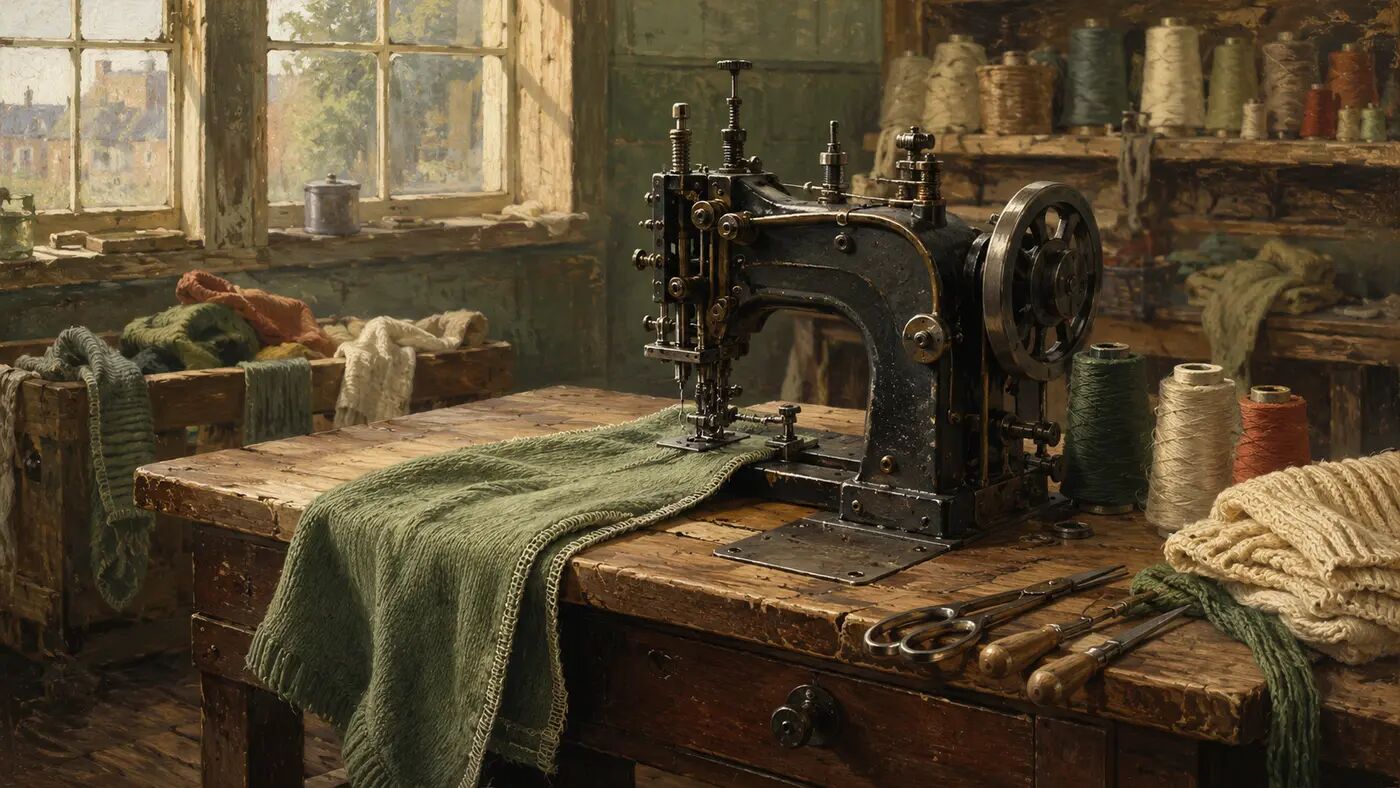
It began with an industrial edge
In the nineteenth century, the Merrow family operated a knitting business in Connecticut. The company records that Joseph Millard Merrow devised its first crochet machine in 1868 to finish the tops of men’s socks in place of handwork. The problem was industrial, but the principle is familiar to any modern sewist: create a secure, flexible finish around a raw edge.
Merrow states that overlock stitching was invented by the company in 1881. Its original three-thread overedge machine became a forerunner of contemporary overlock machines. After the knitting mill was destroyed by fire in 1887, the business concentrated on manufacturing overlock sewing machines. It was formally renamed the Merrow Machine Company in 1893.
The crochet machine
Joseph Millard Merrow devised a machine for finishing the tops of knitted socks.
The overlock stitch
Merrow identifies its three-thread overedge stitch as the forerunner of modern overlocking.
A household prototype
Baby Lock records that Koichi Sakuma developed a smaller home overlocker prototype in Japan.
The Baby Lock debut
The Baby Lock EF-205 and the Baby Lock brand brought the concept of a household serger to market.
Multiple levels of assistance
Buyers can choose from traditional colour-coded threading, assisted lower loopers, air threading and automatic thread delivery.
What made overlocking different
A conventional sewing machine normally forms a stitch within the fabric. An overlock machine forms thread around the edge of one or two pieces of cloth. Industrial machines were designed to produce these seams rapidly and consistently. Domestic machines brought the same basic combination of trimming, stitching and edge finishing into the home.
The cutting system is part of the distinction. As the fabric feeds through the machine, a knife can trim the edge before the looper threads wrap it. That is why learning to control seam allowance, cutting width and differential feed matters as much as learning the tension dials.
From the factory floor to the sewing room
Baby Lock’s account describes a Japanese factory employee redesigning the industrial overlocker as a smaller and more convenient household machine. A prototype was developed by 1963, followed by the Baby Lock EF-205 and the brand’s debut in 1968. The change was more important than simply reducing the machine’s size. It gave home sewists a practical route to garment edges that resembled factory production.
The progression was about reducing friction
Early domestic machines still required the user to understand thread order, looper paths and mechanical tension. Later designs added clearer colour coding, easier looper access, differential feed, simpler rolled-hem conversion and broader stitch choices. Current premium models can use air to move thread through the loopers, and some systems reduce or remove manual tension decisions.
This leads to an important buying lesson. A newer threading system may reduce setup frustration, but it does not automatically make every premium machine the right purchase. Stitch needs, fabric control, support, servicing and the learner’s tolerance for manual threading still determine value.
Why the history matters to our reviews
Modern machines sit on a progression rather than a simple good-to-bad scale. A reliable mechanical serger may preserve more of the traditional learning process at a lower price. An air-threaded machine may justify its cost for someone whose main barrier is threading. Our reviews will therefore compare machines by the problem they solve, not merely by how many features they list.